Friday, October 28, 2011

Hansel: The Social Network


Facebook is incredibly influential on the adolescents’ lives. The way we socialize is vastly different due to Facebook. For example, one of my best friends today is largely due to Facebook. I did not know him too well in real life, but I was Facebook friends with him. I started noticing that his posts and comments were quite hilarious and coincided with my sense of humor. Gradually, I started talking to him in school more and more often to the point where we became full on friends. Another example is how my mother continues to associate with her old high school friends displaced to other parts of the country. Due to Facebook, high school reunions are much easier to schedule. I also know some friends of mine who have suffered due to Facebook. This involved so called “cyber bullying.” Whether or not this is right, I do not believe in any way that there should be government regulations on social networking sites.  We should not waste our money making sure some kid does not get bullied on Facebook. It is not the government’s responsibility to do this, nor should it be in their power. If Facebook starts to abuse its power, people will simply stop using it. If they do not, it is their fault for partaking in something like that. Facebook knows this, which keeps them from abusing the power.
I know of some other social networking sites, most of them are less socially influential than Facebook. One of them is Tumblr, which is a blogging website. You can post text, however it is mostly meant to blog, or reblog, pictures that you think are cool.   Twitter involves nothing but status updates, most of which are along the lines of “My sheets were all twisted up today. #firstworldproblems” or the less popular “My soccer team kicks ass, but my brother runs a drug cartel. #secondworldproblems.” I have not really noticed any sort of social influence with Tumblr, other than possibly breeding a generations of whiny, introspective teenage photographers. Twitter, however, has a lot of influence. For example when Reggie Bush posted “Nice knowing u, New Orleans”, or something of the sort. Everyone interpreted it as him being traded away from the Saints. There was a big fuss over the whole situation. Similar occurrences have been reported involving athletes and celebrities of the like.


Friday, October 21, 2011

Hansel: West Wing

I do not think that the White House depiction in the pilot episode of the West Wing is entirely accurate. It reminds me of Mr. Smith Goes to Washington in the sense that it is an accurate depiction of government in aesthetic, but not in action. Both Mr. Smith and West Wing involve synthesized action created by the hopes and opinions of the writers of what government should be. I believe that, like Mr. Smith, the pilot episode of The West Wing is a bit idealistic, particularly at the end when Jed (Martin Sheen) plays the daddy role to everyone in the office. If presidents were consistently able to be such perfect heroes, the country's problems would be far less significant. The president created in The West Wing reminds me of the hyper-competent sheriffs that are the protagonists in Western films. They basically have no flaws past that of some sort of cutesy quirk, such as running a bicycle into a tree. In addition, I doubt the problems of the White House officials are as juicy and scandalous as the ones the pilot. If so, they cannot be that consistent. The writers had to make it more entertaining, so they added the prostitute subplot. Franklin D Roosevelt (or was it Theodore Roosevelt?) is often considered a successful president because he was very populist in his policies, often mirroring that of the general population's opinion.

It is impossible for a president to fulfill all of the goals presented during campaigning. Candidates holler lofty goals, such as social healthcare and no more foreign energy dependence. One person alone, however cannot fulfill all of these goals. Whenever change must be brought about, it is best to approach it from the bottom up, meaning with the people. If one person is trying to arrange all of these policies, even with multiple degrees and assistance of advisers, he is bound to estimate wrong on some of them. Also, in such a large system as American government, even the president can not make an enormous difference given the system of checks and balances. This is not to imply that checks and balances are wrong, but that changes should be made through an organized, populist movement. We need candidates that reflect the general population, which is almost impossible due to the corporate allocations given during presidential campaigning. Populist candidates such as Al Gore, John Edwards, and Ron Paul have not done well in elections, therefore the incentive for populist support is low.


Photo acquired from tigersweat.com

Friday, October 14, 2011

Hansel: Socialism

Socialism: any of various economic and political theories advocating collective or governmental ownership and administration of the means of production and distribution of goods. This definition is from the merriam webster's dictionary website. At the risk of sounding objective to the assignment, this is almost exactly how I previously defined socialism. The only difference would be in an additional emphasis on the equal distribution of goods that the definition does not include. I must state that my entire argument of socialism is not comprised of "incentive." That is merely my objective case relative to capitalism. My other main argument against socialism is that the government runs production and distribution of goods. In an ideal sense, how is this at all a people's government? As an advocate of liberty and a economic system run by spontaneous order,  I do not believe this would at all be an effective means of production. Without competition, how would the government know what to produce on time? Just look at communist Russia, when people had to wait in line to get simple things. 


http://votebits.com/wp-content/uploads/2011/08/socialism1.jpg
Well, this is pretty skewed, the world socialism under the communist arm and hammer. This is most likely not from a particularly reliable source. Communism and socialism are completely different political systems and to claim things such as Obama being a communist are purely ignorant. I will not spend too much time discussing it.

http://aaronjelcock.files.wordpress.com/2011/03/socialism_poster.jpg
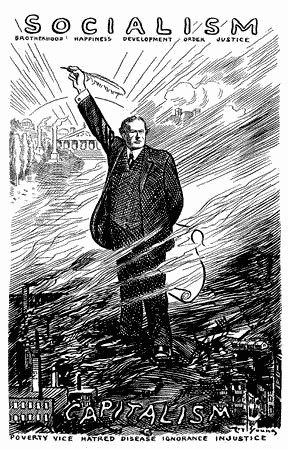
I had to do some extensive browsing, but I finally found a positively slanted view on socialism. One thing I have a problem with is the word "hatred". Free market capitalism actually encourages friendliness through the means of buying. If Chris has money and needs paper towels, and Sean has paper towels and needs money, this transaction works out for the better for both of them. Through the intent of improving Chris's life, he has made Sean's life better, as well. How is that hatred? Also, how is it justice, as one of the words associated with socialism, to have a significant portion of a middle class citizen's wealth taxed and given to those who do not work as hard to forward their lives?


http://blog.jonolan.net/wp-content/uploads/2010/03/socialism-illustrated.jpg
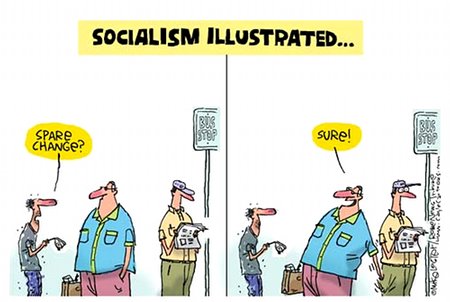
Of all the three interpretations, I can say I agree with this one the most. It is undoubtedly slanted objectively towards capitalism. In the ideal socialist sense, the blue shirt man would give his money to the apparent homeless man, but that is not completely the sense. If the blue shirt man were to give his own change to the homeless man, that would be something possible in capitalism, because the blue shirt man has the freedom to do with his money what he pleases. The man being pick pocketed most likely does not want to give his money away, as he might not be of favorable financial well-being. The yellow shirted man does not have a choice, however.

Friday, October 7, 2011

Hansel: Capitalism: A Love Story

Image acquired at failblog.com
I believe films with a heavy bias can change people's minds. Conversely, Capitalism: A Love Story did not change my mind in any way. It did have an effect on me in the sense that I looked into the theories of capitalism and socialism more in depth in an attempt to discuss the two better. One scene in particular that I found interesting, is the scene in which Moore attacks Reagan's "letting the bull loose" policy that resulted in significant job loss. As an advocate of free market capitalism, this was particularly jarring. In another scene that I thought fell almost completely flat, Moore uses Hurricane Katrina as a representation of capitalism at its worst. Practically everyone in the theater scoffed at its pure lunacy. 

Moore does not try to find common ground because he has several of his own ideas that he would like to portray instead of showing pro-capitalist arguments. Within the confines of time due to the mainstream movie market, he cannot make the film too long. One must remember that Capitalism is not entirely a persuasive documentary, but also a produced film with the intent on selling well. This confinement might not necessarily forward the most intelligent and respectful arguments. This is why I think Frontline does a better job in portraying the wall street bailouts. The problem with Frontline, however, is that is not nearly as entertaining as Moore's film. Frontline focuses more on giving straight information in the form of narration, photography, and direct words from individuals involved. Capitalism, however, uses emotional response, music, and even sarcasm to convey points. The latter is much more entertaining to watch and still gets the point across. It sacrifices detail, however. If a student in free enterprise were to approach me asking about the financial meltdown for a particular assignment or project, I would tell him or her to consult the Frontline special regarding the topic. If this student just wanted to know a little bit about it and did not seem extremely interested already, I would recommend Capitlism: A Love Story. In Moore's defense, I think he makes his films entertaining and you get a pretty good idea of his opinions and justifications. Although, at times, he dances on the edge of yellow journalism in the sense that everything can be sensationalized. For example, comparing capitalism and hurricane Katrina? How many people does he honestly think he can convince with that one? I also did not appreciate how much of the documentary was spend with footage of people crying. I realize emotion is a large part of argument, but in an argument of capitalism as quantitative as this, it is not in good taste as far as a respective argument goes.

Friday, September 30, 2011

Hansel: Drug War

http://www.leftycartoons.com/
There is very little that I can say regarding the war on drugs that has not already been stomped into the ground repeatedly by anyone with the proper ability to observe and analyze national occurrences.  Despite the fortune being dumped into the drug war, no improvement has been made.  (Sounds kind of like public education, but that's a whole other  issue.)  There are also other costs of the drug war, including broken up families, loss of constitutional rights, and spots in America's already severely overcrowded prisons.  Personally, I do not think that any sort of unity between Mexico and the United States, nor any sort of improvements in the policies will benefit the Drug War. Call me a pessimist, but drug policies have been tested and failed for entirely too long in America.  One would think that the government would pick up on this sort of consistent failure in policy, but what can you say?  Our friend Mario claimed that marijuana legalization would help the drug problem in the United States, and I strongly agree with him.  Often, in the legalization arguments, I hear that government regulation of the product will help prevent from unsafe condition of marijuana.  This, on the other hand, I do not even agree with.  What parents often worry about with pot is that some teenager is going to wind up with a bag of shitty Mexican dirt weed that is laced with cocaine and is going to kill their little  white Rastafarian poser son. This is a problem that is not only highly uncommon, but is also a problem that could be solved almost entirely by legalization of marijuana. Said white Rastafarian poser son is not very apt to visit the hospital when he starts feeling a little too funny from this tainted bag of herb, due to the regulations on his previous activities.  If companies were able to compete with marijuana sales on the terms of quality of the product, it will result in safer bags.  Said "shitty Mexican dirt weed" will become extinct, not to say that we would no longer import the product from Mexico, especially given how much America loves to consume other nations' goods. This will result in legal, less dangerous methods of crossing the border.  Let's say, for the sake of continuing the suburb boy narrative, pot is legalized, and this boy, for whatever reason, still buys pot from his friend down at the alley by Piggly Wiggly.  If this bag is tainted, he is much more apt to go to the hospital and get treatment.  This situation would be practically extinct in the days of legalization.  The previously mentioned point, in my opinion, would not only apply to marijuana, but to cocaine.  Obviously, the still existing laws regarding cocaine would be much more harsh as to refraining from driving, how much is legal to own, the age limit.  The points I hear against cocaine are often regarding the quality and the quantity.  People are afraid that the product will have other harmful, deadly contents, which is a problem eradicated by legalization.  Also, people worry that they will overdose.  Of course, this would still exist in the days of legalization, but treatment centers and regulations would help those in need of such just as treatment for smokers and alcoholics already exist.  I know several other points that support legalization, but I do not want to ramble on.  If you would like to hear more points regarding legalization, you should follow the link I put at the bottom regarding such.
http://www.hightowerlowdown.org/  

Thank you for reading, please enjoy the links I put up.  Most of them are from a website run by the Ludwig von Mises Institute, a "think tank" of sorts for Austrian economics and libertarian theory. I spend a lot of my day on this site.

Friday, September 23, 2011

Hansel: American History X

        American History X showcases notions of white supremacy while also presenting interjections. Few of these interjections are heard out, however. An example is the dinner scene in which Derek rants about Rodney King’s trial. Murray’s opinions are heard, but he presents them rather meekly, thus stripping his argument of its validity, in a sense. Absolutely no interjections are heard when Derek is being lectured by his father on his problems with Dr. Sweeney’s teaching style. Also, Derek gives a speech to all of his white supremacist cronies in their younger stages of bigoted organization. Most of the prejudiced opinions are presented in monologue form, as if giving the floor to these views. One could claim that this glorifies the opinions, which I began to believe myself until I took on a new standpoint on the screenplay. I think David McKenna wrote the screenplay this way to help the viewer hear the unpopular Neo-Nazi viewpoints and think of his or her own rebuttals instead of being spoon-fed a certain opinion. This assumes that the view is not a neo-Nazi, however. Neo-Nazis might interpret this movie as an inaccurate depiction or try to point out faults in Derek’s character that led to him losing sight of such a noble cause. I’m not exactly the consultant for that, however.
        Personally, I respect Tony Kaye for involving such harsh images in the film.  It helped portray the gruesome realities of impressionable teenagers of the lower class looking for a cause and meaning to their lives. Jarring portrayals such as the shower rape scene, the curb stomp scene, and the final death of Danny scene leave strong images in the viewers’ minds. These strong images leave lasting effects. The film shows how there is virtually no solution to the prejudice and racism will always exist among lower class areas of the world. The government cannot do anything about it, because although prejudice has gradually decline through the history of mankind, it will never get to a complete racial blindness.  While I am in no way prejudice, I believe that is how a significant part of the world functions.  People will always find a way to divide themselves, no matter how well the world is connected through information and communication. 

Since I feel really bad for being such a Debbie Downer, I’ll post a lovely gif to brighten things up...
Images acquired from www.ebaumsworld.com and www.tumblr.com, respectively.

Thursday, September 15, 2011

Hansel: Good Night and Good Luck

Good Night and Good Luck and The Crucible both employ the theme of McCarthyism in the simultaneous use of parallelism.  Good Night and Good Luck paralleled McCarthyism with government actions such as the Patriot Act and the constant fear of terrorism.  The Crucible, however, paralleled the Salem Witch Trials with McCarthyism, which was a current issue when Arthur Miller published the Tony Award winning play in 1953.  What George Clooney was trying to portray as director and co-screenwriter of the film was quite reminiscent of Arthur Miller’s intent.  Both of the films offer jarring social commentary for their appropriate times, but I prefer to compare Good Night and Good Luck with one of my favorite films that just so happens to relate to the Red Scare:  Dr. Strangelove or: How I Learned to Stop Worrying and Love the Bomb.  These two films offer commentary on the United States’ dealings with Russia and communism, but in different lights.  Dr.  Strangelove is more of a humorous interpretation of the Red Scare.  This is evident through the constant use of phallic symbols, character parts, and utter exaggeration of ideals scarily similar to that of actual government officials at the time.  Good Night and Good Luck is more of a haunting rendition designed to make the audience more aware through emotional response more serious than that of the satirical Dr. Strangelove, shown by the stoic line delivery, the constant smoke stained shots, and the almost always intimate proxemics.  Though their intents differed, Stanley Kubrick and George Clooney used similar directing styles for their films.  One that particularly stood out was the use of black and white.  Also, the use of tight framing in practically all of Night is reminiscent of the office scenes in Dr. Strangelove.  One directorial facet of Clooney’s that I particularly enjoyed in the film was his use of music playing over scenes without hearing the actual scenes.  Kubrick employs this technique in the final mushroom cloud scene of Dr. Strangelove.  Finally, I have to note the aspect of Good Night and Good Luck that originally caused the link between the film and Kubrick’s.  In class, Tuesday, Prof.  McCay noted the aluminum ad that included a farmer shoveling manure, inherently implying what?  BULLSHIT.  That is exactly what American citizens were being fed through the media in the 50’s.  This type of symbolism is reminiscent of Kubrick’s use of cigars, missiles, planes, and god-knows-what-else as phallic symbols.  If I begin to think of any more parallels or interesting contrasts between the two films, I will add them to the 
blog.


Images aquired from http://dc340.4shared.com/ and http://www.jonathanrosenbaum.com, respectively.