Monday, November 28, 2011

Hansel: District 9

I appreciate the social commentary of District 9 in their parallels with apartheid and xenophobia in general, but I think the filmmakers went about doing it in a way that almost took their credibility. The film gets a tad silly and hard to take seriously at times, particularly involving cat food for exchange. Silliness aside, I would like to address the message of the film that I enjoyed noting: xenophobia. The film shows how easy it is to despise a race of people because their customs and appearance. In the film, humans disown the aliens because of their appearance and behavior that humans found objectionable. This aspect obviously mirrors our idea of races and how cultural difference can separate societies. If we had looked past the differences, we would have cooperated with the prawns in order to better society in harmony with them. Instead, because of their ghastly cultural differences, we banish them and force them to a distinct part of the world. The parallels with the aliens fit well many a time, in my opinion. However, the Christopher Johnson story was hard to take seriously in the sense that he looks like a giant cricket but expresses sympathy, intelligence, and human body language and traits. In addition Christopher’s son was anything but cute and adorable. I realize that is the point the filmmakers tried to make, but I think science fiction writers must be careful when they make films that speak so much about society because they are bound by the fine line between silliness and respectable satire. Perhaps District 9 is supposed to be campy in some way, but they did not make it totally clear. The mockumentary style of film making was very creative and made the film much more entertaining to watch. It makes it more believable in a sense that if we were actually living through it, we would be viewing the story through media. In my opinion, this is one of the best formats for a socially topical film like this. It works for any film, however. I particularly remember from 2008, Quarantine being quite the scary film because of it's video camera plot style.
http://drnorth.files.wordpress.com/2009/09/distrcit-9-sign1.jpg

Friday, November 11, 2011

Hansel: Restrepo

The way Sebastian Junger wrote the article made it sound even more personal, how it was directed to Tim Hetherington personally. It shows how serious war media should be. I’m not saying every journalist should go out and risk their lives to get the news to people. Obviously, someone like a fashion or sports journalist would not be expected to do so. However it took pure journalistic passion of the two men to deploy themselves in Korengal Valley, one of the most dangerous places in Afghanistan. I found it interesting that Junger mentioned the two journalists’ affinity for risk. It almost made them sound like soldiers themselves, like the guy who talked about how he does not know how he’ll make it back in America because of his love for shooting guns and the natural high that results. I imagine what kept them pushing through the terror they must have felt was the idea that they were going to get the truth to those whom have never seen what it’s like for soldiers in Afghanistan Media like this helps the overall mindset Americans have towards war, in my opinion. Through documentaries like Restrepo, civilians get a more accurate impression of what war is like now. This could affect their decisions in voting for a president that might be anti or pro-war. Regardless of how it makes them feel, it educates their standpoint more. Seeing numbers of how many soldiers died in a war has a temporary emotional impact, but not a lasting one. We see them as just numbers in a battle against the enemy. Through the documentary, we see them as human, not only in combat, but also eating and joking around with friends. The most affective scenes, in my opinion the ones in which the soldiers mention their family, like when the guy is working on his gun talking about his ranch back home. Also, when they are in the mess hall wrestling around with the cook, we get to see the human aspect of the soldiers. This might not be all too much of a change for someone whose family member is in the service, but for me the documentary provided a good outlook on men at war and the emotional effects that result.

Image acquired from 
http://www.clarksvilleonline.com

Friday, November 4, 2011

Hansel: Rendition

Torture is wrong legally, morally, and rationally. By legally, I mean that the United States government is not following due process with the law OR rules of war established in the Geneva Convention. One does not generally see countries doing this. It just fuels the idea of Americans feeling superior. Morally, most people would agree that torture is correct. Often, this is overlooked due to the fact that people claim terrorists should not be treated as human beings, but as thugs. We can see this by the look on Douglass Freeman’s face as he witnesses the torture. Rationally, torture does not work. The article titled “Outsourcing Torture” includes a section on it. We can even see it in “Rendition” by the fact that Jeremy El-Ibrahimi just listed names from a soccer team. Torture goes against the fourth, fifth, and eighth amendments to the Constitution. The fourth, against illegal search and seizure, is broken simply by them stripping the suspected terrorist of his clothes. The fifth, due process, is obviously broken by the fact that they are punishing suspect terrorists without due process. The eight amendment, forbidding cruel and unusual punishment, is broken simply by the fact that what the torturers are doing in quite cruel and unusual. One of my questions regarding torture was how did it come about. Admittedly by one of the men who instated it, Michael Scheuer, it was created out of desperation. The government simply did not know what to do with the terrorism problem. I try not to directly crucify those who established the program because I can not think of another way to fight terrorists. When a nation is at war against ideas, such as religious terrorism, the rules of war might not always apply, especially in the case of the enemy using tactics that ignore the rules of war, as well. For example, how do we stop suicide bombers if they believe that they well be martyred? The threat of death does not stop them. Neither does shooting the terrorist while he is strapped with a bomb because of the dead man trigger where the bomb deploys when the grip is lost.

Acquired from cartoonstock.com

Friday, October 28, 2011

Hansel: The Social Network


Facebook is incredibly influential on the adolescents’ lives. The way we socialize is vastly different due to Facebook. For example, one of my best friends today is largely due to Facebook. I did not know him too well in real life, but I was Facebook friends with him. I started noticing that his posts and comments were quite hilarious and coincided with my sense of humor. Gradually, I started talking to him in school more and more often to the point where we became full on friends. Another example is how my mother continues to associate with her old high school friends displaced to other parts of the country. Due to Facebook, high school reunions are much easier to schedule. I also know some friends of mine who have suffered due to Facebook. This involved so called “cyber bullying.” Whether or not this is right, I do not believe in any way that there should be government regulations on social networking sites.  We should not waste our money making sure some kid does not get bullied on Facebook. It is not the government’s responsibility to do this, nor should it be in their power. If Facebook starts to abuse its power, people will simply stop using it. If they do not, it is their fault for partaking in something like that. Facebook knows this, which keeps them from abusing the power.
I know of some other social networking sites, most of them are less socially influential than Facebook. One of them is Tumblr, which is a blogging website. You can post text, however it is mostly meant to blog, or reblog, pictures that you think are cool.   Twitter involves nothing but status updates, most of which are along the lines of “My sheets were all twisted up today. #firstworldproblems” or the less popular “My soccer team kicks ass, but my brother runs a drug cartel. #secondworldproblems.” I have not really noticed any sort of social influence with Tumblr, other than possibly breeding a generations of whiny, introspective teenage photographers. Twitter, however, has a lot of influence. For example when Reggie Bush posted “Nice knowing u, New Orleans”, or something of the sort. Everyone interpreted it as him being traded away from the Saints. There was a big fuss over the whole situation. Similar occurrences have been reported involving athletes and celebrities of the like.


Friday, October 21, 2011

Hansel: West Wing

I do not think that the White House depiction in the pilot episode of the West Wing is entirely accurate. It reminds me of Mr. Smith Goes to Washington in the sense that it is an accurate depiction of government in aesthetic, but not in action. Both Mr. Smith and West Wing involve synthesized action created by the hopes and opinions of the writers of what government should be. I believe that, like Mr. Smith, the pilot episode of The West Wing is a bit idealistic, particularly at the end when Jed (Martin Sheen) plays the daddy role to everyone in the office. If presidents were consistently able to be such perfect heroes, the country's problems would be far less significant. The president created in The West Wing reminds me of the hyper-competent sheriffs that are the protagonists in Western films. They basically have no flaws past that of some sort of cutesy quirk, such as running a bicycle into a tree. In addition, I doubt the problems of the White House officials are as juicy and scandalous as the ones the pilot. If so, they cannot be that consistent. The writers had to make it more entertaining, so they added the prostitute subplot. Franklin D Roosevelt (or was it Theodore Roosevelt?) is often considered a successful president because he was very populist in his policies, often mirroring that of the general population's opinion.

It is impossible for a president to fulfill all of the goals presented during campaigning. Candidates holler lofty goals, such as social healthcare and no more foreign energy dependence. One person alone, however cannot fulfill all of these goals. Whenever change must be brought about, it is best to approach it from the bottom up, meaning with the people. If one person is trying to arrange all of these policies, even with multiple degrees and assistance of advisers, he is bound to estimate wrong on some of them. Also, in such a large system as American government, even the president can not make an enormous difference given the system of checks and balances. This is not to imply that checks and balances are wrong, but that changes should be made through an organized, populist movement. We need candidates that reflect the general population, which is almost impossible due to the corporate allocations given during presidential campaigning. Populist candidates such as Al Gore, John Edwards, and Ron Paul have not done well in elections, therefore the incentive for populist support is low.


Photo acquired from tigersweat.com

Friday, October 14, 2011

Hansel: Socialism

Socialism: any of various economic and political theories advocating collective or governmental ownership and administration of the means of production and distribution of goods. This definition is from the merriam webster's dictionary website. At the risk of sounding objective to the assignment, this is almost exactly how I previously defined socialism. The only difference would be in an additional emphasis on the equal distribution of goods that the definition does not include. I must state that my entire argument of socialism is not comprised of "incentive." That is merely my objective case relative to capitalism. My other main argument against socialism is that the government runs production and distribution of goods. In an ideal sense, how is this at all a people's government? As an advocate of liberty and a economic system run by spontaneous order,  I do not believe this would at all be an effective means of production. Without competition, how would the government know what to produce on time? Just look at communist Russia, when people had to wait in line to get simple things. 


http://votebits.com/wp-content/uploads/2011/08/socialism1.jpg
Well, this is pretty skewed, the world socialism under the communist arm and hammer. This is most likely not from a particularly reliable source. Communism and socialism are completely different political systems and to claim things such as Obama being a communist are purely ignorant. I will not spend too much time discussing it.

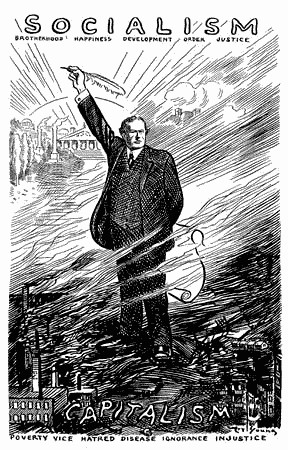
http://aaronjelcock.files.wordpress.com/2011/03/socialism_poster.jpg
I had to do some extensive browsing, but I finally found a positively slanted view on socialism. One thing I have a problem with is the word "hatred". Free market capitalism actually encourages friendliness through the means of buying. If Chris has money and needs paper towels, and Sean has paper towels and needs money, this transaction works out for the better for both of them. Through the intent of improving Chris's life, he has made Sean's life better, as well. How is that hatred? Also, how is it justice, as one of the words associated with socialism, to have a significant portion of a middle class citizen's wealth taxed and given to those who do not work as hard to forward their lives?


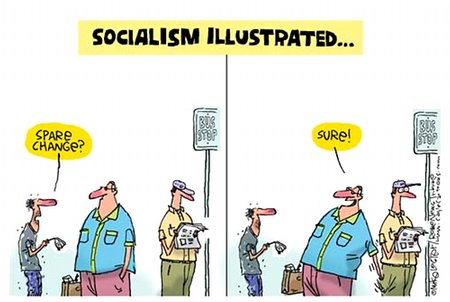
http://blog.jonolan.net/wp-content/uploads/2010/03/socialism-illustrated.jpg
Of all the three interpretations, I can say I agree with this one the most. It is undoubtedly slanted objectively towards capitalism. In the ideal socialist sense, the blue shirt man would give his money to the apparent homeless man, but that is not completely the sense. If the blue shirt man were to give his own change to the homeless man, that would be something possible in capitalism, because the blue shirt man has the freedom to do with his money what he pleases. The man being pick pocketed most likely does not want to give his money away, as he might not be of favorable financial well-being. The yellow shirted man does not have a choice, however.

Friday, October 7, 2011

Hansel: Capitalism: A Love Story

Image acquired at failblog.com
I believe films with a heavy bias can change people's minds. Conversely, Capitalism: A Love Story did not change my mind in any way. It did have an effect on me in the sense that I looked into the theories of capitalism and socialism more in depth in an attempt to discuss the two better. One scene in particular that I found interesting, is the scene in which Moore attacks Reagan's "letting the bull loose" policy that resulted in significant job loss. As an advocate of free market capitalism, this was particularly jarring. In another scene that I thought fell almost completely flat, Moore uses Hurricane Katrina as a representation of capitalism at its worst. Practically everyone in the theater scoffed at its pure lunacy. 

Moore does not try to find common ground because he has several of his own ideas that he would like to portray instead of showing pro-capitalist arguments. Within the confines of time due to the mainstream movie market, he cannot make the film too long. One must remember that Capitalism is not entirely a persuasive documentary, but also a produced film with the intent on selling well. This confinement might not necessarily forward the most intelligent and respectful arguments. This is why I think Frontline does a better job in portraying the wall street bailouts. The problem with Frontline, however, is that is not nearly as entertaining as Moore's film. Frontline focuses more on giving straight information in the form of narration, photography, and direct words from individuals involved. Capitalism, however, uses emotional response, music, and even sarcasm to convey points. The latter is much more entertaining to watch and still gets the point across. It sacrifices detail, however. If a student in free enterprise were to approach me asking about the financial meltdown for a particular assignment or project, I would tell him or her to consult the Frontline special regarding the topic. If this student just wanted to know a little bit about it and did not seem extremely interested already, I would recommend Capitlism: A Love Story. In Moore's defense, I think he makes his films entertaining and you get a pretty good idea of his opinions and justifications. Although, at times, he dances on the edge of yellow journalism in the sense that everything can be sensationalized. For example, comparing capitalism and hurricane Katrina? How many people does he honestly think he can convince with that one? I also did not appreciate how much of the documentary was spend with footage of people crying. I realize emotion is a large part of argument, but in an argument of capitalism as quantitative as this, it is not in good taste as far as a respective argument goes.